Why Registration Week Overwhelms Your Support Team Every Year
- Student Support
- Posted: 3 months ago
Registration week has always been the hardest two weeks of your year. What has changed is that the spike no longer lives inside those two weeks. Inbound queries start climbing a month before census, and the backlog from one cycle is often still in someone’s inbox when the next one begins. You know the rhythm, and you plan for it, and every year the same complaints land on the same desks anyway.
The familiar response is to throw bodies at the problem: temporary front-desk staff, redeployed colleagues from quieter offices, overtime rosters for the permanent team. It keeps the phone lines moving, but it doesn’t stop the missed deadlines or the team members you’ll lose to resignation by March. The issue isn’t effort, and it isn’t your team. It’s that you’re running an architecture built for steady-state volume, and registration week doesn’t arrive in a steady state.
The registration week cycle every registrar knows
If you mapped your inbound volume across the calendar, four repeating phases would show up:
- Calm in the middle of the semester
- Rising wave in the weeks before registration opens
- Storm during registration and the first fortnight of term
- Damage control in the month that follows, as your team works through the backlog
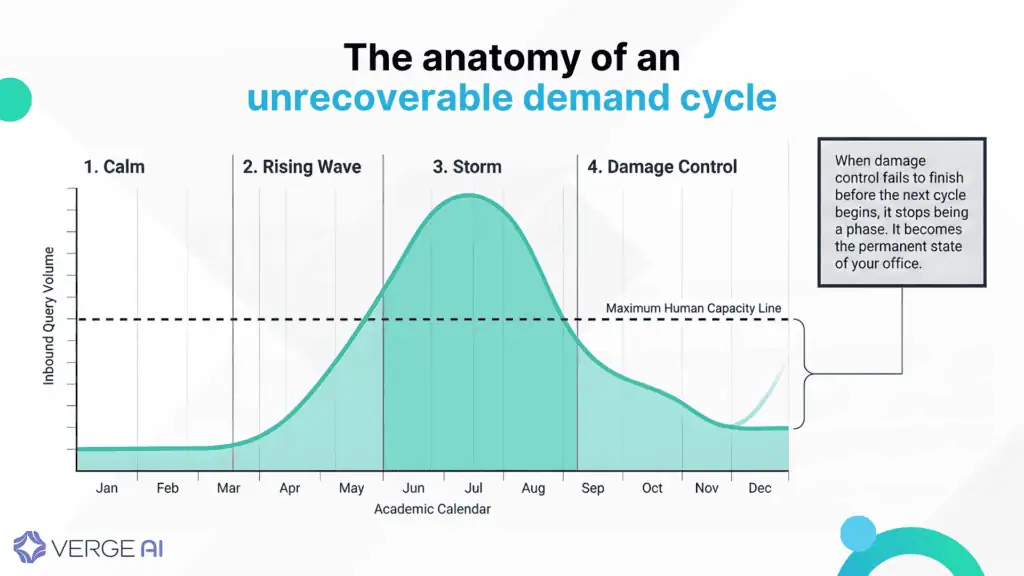
You’re not unusual in experiencing this pattern. What separates a manageable cycle from an unrecoverable one is whether damage control finishes before the next cycle begins.
When that happens, damage control stops being a phase. It becomes the permanent state of the office.
Why hiring more people doesn’t fix registration week
The instinct to hire your way through registration week is sound, but the arithmetic rarely supports it. Pick whatever multiple your peak season runs over a quiet week. Absorbing it through hiring requires roughly that same multiple in trained staff, for those same two weeks. That’s neither budgetable nor operationally realistic.
There’s also a training cost buried inside the temp-staff model that’s easy to miss. A new hire answering registration questions needs to know a lot: your course catalogue, fee structure, late-registration rules, financial aid exceptions, and transfer credit policies, at a minimum. By the time they’re competent, the spike is over. You pay the cost again at the next one.
And the labour market makes the gap worse
According to AACRAO’s 2021 survey of registrars’ offices, 53% of institutions had one or more current vacancies, and 70% of those reported the vacancies as “difficult” or “very difficult” to fill.
That’s the constraint that makes temporary staffing harder than it should be. You can’t hire your way out of a capacity problem in a labour market where you can’t reliably hire your way into your permanent roles.
The backlog has a cost, and most of it is not in your budget line
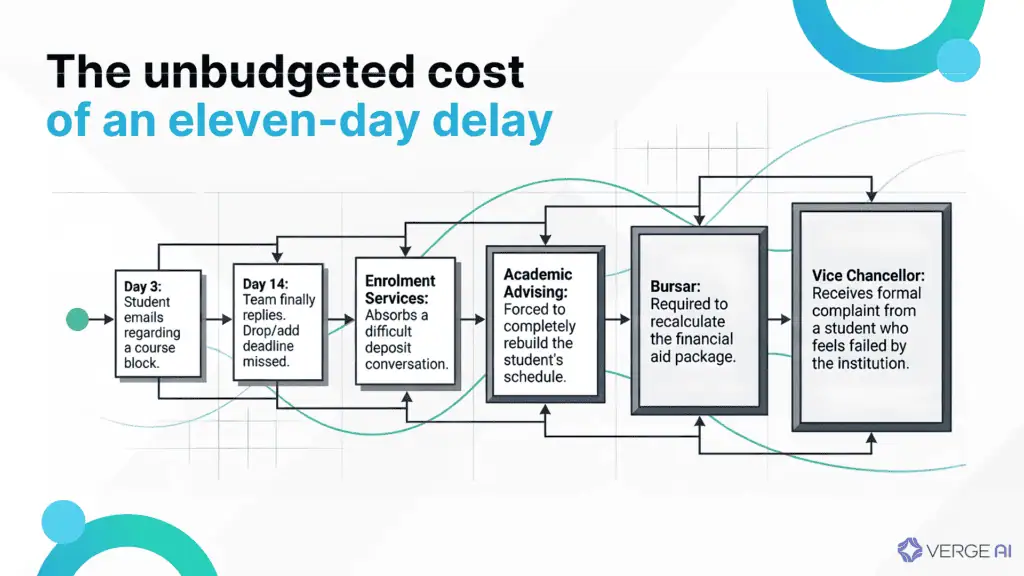
Picture a student who emails your office on day three of registration and receives a reply on day fourteen. They miss the drop/add deadline. They enrol in a course they didn’t want and drop one they needed. Your team has to recalculate their financial aid package. A complaint lands on the Vice Chancellor’s desk.
That single interaction spreads costs across offices that don’t appear in your budget line. Enrolment Services absorbs the deposit conversation, Academic Advising handles the schedule rebuild, and the Bursar reruns the aid calculation. Your team carries the complaint with the emotional weight of a student who has started the year feeling failed by the institution.
The cost that’s hardest to quantify
The internal cost compounds. Staff burnout during peak season isn’t a metaphor. It’s one of the causes behind the vacancies AACRAO documented, and it’s the reason institutional memory of how registration actually works keeps walking out the door.
The registration week demand curve your support model ignores
If you scanned your team’s inbox during peak season, the same handful of questions would show up over and over:
- How to add a course after the deadline
- Where to upload proof of payment
- How to confirm enrolment
- Which form the financial aid office needs this week
This isn’t a criticism of your team or your students. It’s a fact about the shape of demand, and it points at a structural fix that temp staffing can’t deliver. If you handled the routine share differently, your permanent team would have the capacity to handle the non-routine cases the way they actually need to be handled.
The conventional support model treats the demand curve as if it were flat and every query equally complex. It rarely is.
Demand shaping: answer the queries before students ask them
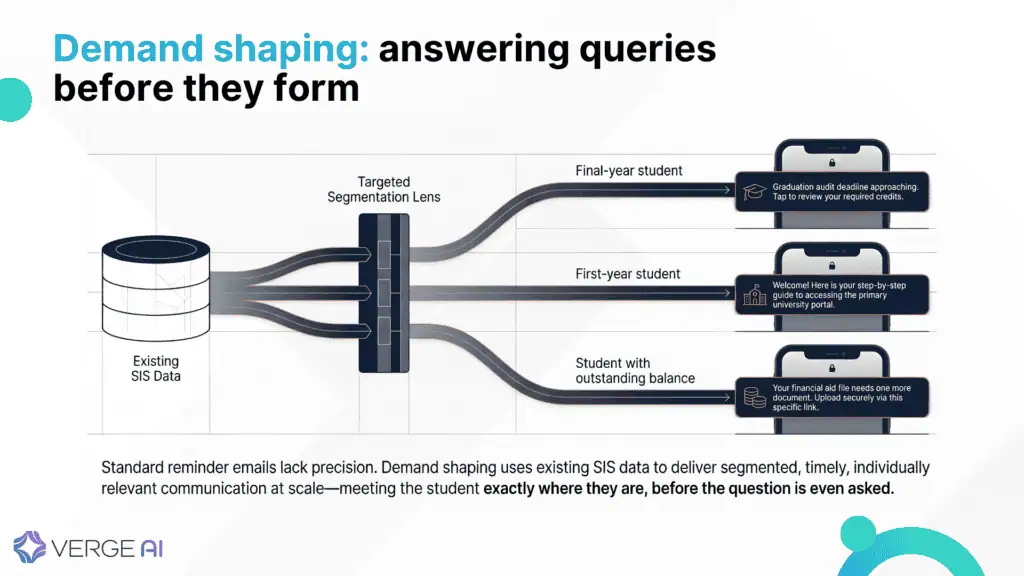
The first half of a peak-season fix is reducing the inbound volume before it arrives. You already do some of this informally: a reminder email when registration opens, a pinned note on the portal, a social post about drop/add deadlines. The gap between those efforts and what demand shaping actually requires is precision and timing.
Proactive, targeted communication cuts inbound queries sharply. The trick is to pitch it at the level of the individual student’s situation. A first-year student receives different information at a different time than a final-year student. A student with an outstanding fee balance receives a different message than one whose aid is already processed. The message meets the student before the question forms.
The data you need to do this already exists in your SIS. The harder part is the layer that turns it into segmented, timely, individually relevant outbound communication at scale. That layer is the first piece of the structural fix.
Intelligent automation absorbs the routine share
The second piece is what happens when the queries arrive anyway. Most registrars have seen the old chatbot model already: a scripted decision tree that recognises a keyword and returns a canned response. What your team needs is something more than that, and more specifically, something else.
EduBot, Verge AI’s AI student engagement platform, is trained on your institution’s own documents and policies. It answers routine queries in natural language, across the channels your students actually use, at the moment the question is asked. A student can ask about your specific late-registration policy, your specific fee schedule, or this term’s drop/add deadline, in Zulu or Afrikaans or English, on WhatsApp at 2 am.
When a question is out of its scope, the platform hands off to a human advisor with the full conversation history intact, so the student doesn’t repeat themselves and your advisor doesn’t start from scratch.
The signal underneath the conversation
The capability that often matters most to a registrar’s office, though, isn’t the front-end conversation. It’s the back-end signal. A well-designed platform surfaces:
- Trending query categories that show you which policies are generating the most confusion this week
- Unanswered question flags that reveal gaps in your knowledge base before a student complaint does
- Peak-load patterns that let you staff the live-agent layer against real demand rather than guesswork
- Language and channel mix that shows you which students are being reached and which are being missed
This is the kind of operational picture that’s hard to assemble manually. At the University of the Free State, deploying EduBot reduced live chat requests by 83%. This freed the human support team to focus on the cases that actually required human judgment.
The dividend isn’t only the queries you stop answering manually. It’s a clearer picture of a demand curve that’s hard to see when you’re in the middle of it. Your permanent team stops triaging the same routine questions and starts doing the work they were hired for: exceptions, appeals, advocacy, the cases that need a person with twenty years of institutional knowledge sitting across the desk.
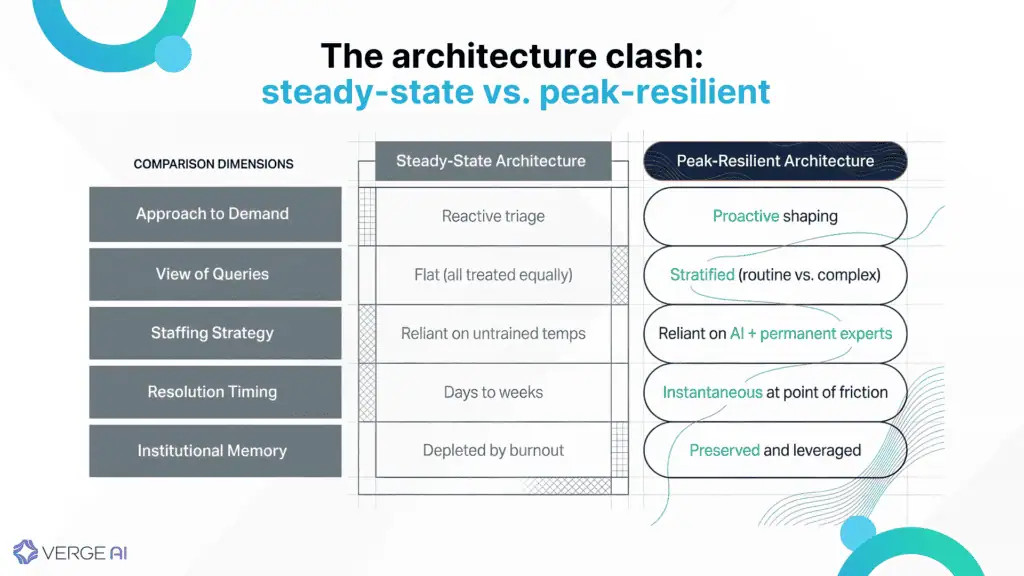
What peak season looks like when the model fits the demand
When your support model fits the actual shape of demand, peak season doesn’t disappear. It stops being a crisis. The first fortnight of term still generates several times the query volume of a quiet week, but a large share of it resolves without touching a human, and the backlog doesn’t accumulate.
Your registrars stop dreading registration week. Your Vice Chancellor stops receiving the same complaints. And the students who get answers at 11 pm on a Sunday have a materially different experience of your institution than the ones who wait eleven days for a reply.
The structural fix for registration week isn’t more people. It’s a support model built for the shape of demand your institution already has.
If you’d like to see what a peak-season-resilient support model looks like in practice, we’d be happy to walk you through how it works at a university that runs the same cycle you do.