Future-Proof Your Campus: The Complete Guide to AI-Driven Student Engagement
- Education
- Posted: 1 year ago
Student engagement is a key component of the success and reputation of higher education institutions.
Did you know that nearly a third of students drop out of university in their first year? This alarming statistic highlights the urgent need for effective engagement strategies to improve retention rates.
The growing demand for personalized and responsive educational experiences means AI-driven solutions can give universities a strategic edge in a very competitive landscape. These technologies can transform the way institutions interact with students, creating deeper connections and boosting overall satisfaction.
This guide provides high-level insights and actionable strategies to implement AI effectively. Adopting these advanced tools can help your campus remain at the forefront of educational innovation and student success.
Trends and Innovations in AI-Driven Student Engagement
AI has been making waves in higher education for a while now. A clear trend is to use AI chatbots for higher education to handle routine tasks like answering student questions. This helps free up valuable time for faculty and staff.
According to a recent report, two-thirds of students found it somewhat or very easy to make the decision to apply to a university. However, over a quarter found it somewhat or very difficult. This is where chatbots can make a significant impact. Chatbots can simplify this process by providing instant, 24/7 support, making it easier for prospective students to find the information they need and make decisions.
Predictive analytics are also gaining traction. These tools provide insights into student behaviour and performance, helping institutions identify and address issues early. This creates a more supportive learning environment.
Innovating Using AI
AI-driven solutions meet the growing demand for personalized learning, directly impacting student engagement and retention—key factors for your institution’s success.
They offer the opportunity to provide customized services that adjust resources to individual student needs. This personalization can lead to higher engagement and better academic outcomes.
Predictive modelling is another breakthrough, allowing institutions to identify at-risk students early and intervene proactively. Early warning systems have been shown to improve academic outcomes. In one case study, students identified as at-risk achieved grades that were, on average, 8% higher than their peers.
Overcoming Key Pain Points in Higher Education with AI
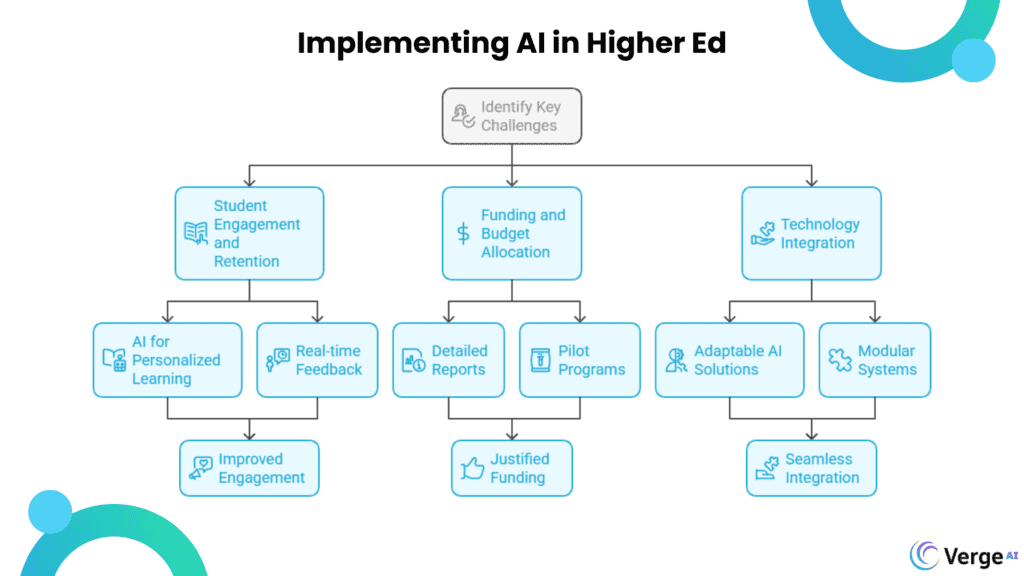
Student Engagement and Retention
One of the biggest challenges in higher education is keeping students engaged and preventing dropouts. AI can help by creating personalized learning paths for each student, making their educational experience more relevant and engaging. Real-time feedback from AI tools can help students understand where they need to improve immediately, keeping them on track. These technologies also allow educators to spot students who might be struggling and offer help before it’s too late.
Funding and Budget Allocation
Justifying the costs of new technology can be tough, especially when budgets are tight. Detailed reports and case studies can show the return on investment, making it easier to argue for funding. Pilot programs are another good way to show initial results and gather data specific to your institution. When you can show that AI tools lead to better engagement, higher retention rates, and improved academic performance, it becomes much simpler to secure the necessary budget.
Technology Integration
The word ‘integration’ usually triggers alarm bells. But it’s actually less daunting than it sounds. Modern AI solutions are designed to be adaptable and scalable. This means they can fit into your current infrastructure with minimal disruption. Modular systems, in particular, are built to allow each component to be independently developed, scaled, and maintained, and ensure that updates or changes can be made without affecting the entire system. This approach makes it easier to transition and upgrade your existing technology infrastructure.
Practical Strategies and Steps to Implement AI-Driven Solutions
Strategic Alignment:
Implementing AI-driven student engagement initiatives requires a strategic and solution-oriented approach to be successful:
- Start by making sure your AI initiatives match your institution’s long-term goals. This ensures that any new technology will support your overall mission
- Long-term goals include outcomes like improving student retention, learning outcomes and streamlining university admin
- Work together across departments to build a unified approach to AI to foster collaboration and a shared understanding
Practical Steps for Implementation:
Implementing AI doesn’t need to be all or nothing. We suggest a structured, phased approach for a smooth implementation:
- Start with small pilot programs to test and refine your AI tools. This allows you to identify what works best before rolling out full-scale solutions.
- Invest in staff training and development. Educating your team on how to use AI tools effectively will maximize their impact and ease the transition to new technology.
- Start with just one department. Implement AI in a single department first to work out any issues and see if it’s a right fit before expanding campus-wide.

Measuring the Success of Student Engagement Inititatives:
Once you’re up and running, don’t set it and forget it. Track the progress and impact of your AI initiatives to make sure you’re on track:
- Use KPIs to monitor your initiative and to assess progress and impact.
- Keep an eye on student retention rates, satisfaction scores, and how much time staff are saving on admin tasks.
- Regularly review these metrics and adjust your strategies based on what the data shows to ensure ongoing relevance.
The Long-Term Benefits of Scalable, Future-Ready AI Solutions
When looking at the long-term benefits of AI solutions for your campus, there are three main things you should consider: scalability, adaptability, and cost efficiency.
Scalability:
Scalability is crucial. AI solutions can grow with your institution to handle more students and adapt to your changing needs without missing a beat. This means you won’t have to worry about outgrowing your technology.
Adaptability:
Next, look at adaptability. Great AI solutions can easily integrate new technological advancements. This means you don’t need to do a major overhaul of your IT systems. AI tools can help you stay agile and incorporate new tools and tech to keep your campus up to date.
Cost Efficiency:
Finally, there are the cost savings you can achieve using AI. AI can automate many repetitive tasks to save you time and reduce your operational costs. Additionally, improving your support and bolstering your student engagement with AI can help boost retention rates.

Is Your Institution Future Proof?
AI-driven solutions can change how your institution engages with students and help you stay ahead in the fast-changing educational world. AI offers personalized learning experiences and automates routine tasks, helping to future-proof your institution.
However, it’s important to make sure these AI initiatives align with your institution’s goals. When AI supports your broader mission, it can be a powerful tool to help you achieve your institution’s long-term objectives.
Next Steps
Ready to future-proof your campus with AI-driven student engagement? Let’s explore how AI can be a strategic investment for your institution. Contact Verge AI today or schedule a demo to see first hand how our solutions can transform student experiences and support your long-term institutional goals.
FAQs
How can AI-driven student engagement tools be integrated with our existing campus IT infrastructure?
Modern AI solutions are designed to be adaptable and scalable, allowing for integration with minimal disruption to current systems.
What initial steps should our institution take to pilot AI-driven student engagement initiatives?
Start with small pilot programs in a single department to test and refine AI tools, gather specific data, and work out any issues before expanding campus-wide.
What types of training do staff need to effectively use AI tools for student engagement?
Invest in training programs that cover the use of AI tools, data interpretation, and best practices for AI-driven student support.
How can we measure the return on investment (ROI) for AI-driven student engagement solutions?
Monitor key performance indicators such as student retention rates, satisfaction scores, and administrative time savings to evaluate the financial and operational impact.
How do AI-driven predictive analytics specifically help in identifying at-risk students?
Predictive analytics analyze patterns in student behaviour and performance data to flag potential issues early, enabling timely interventions to support at-risk students.
What are the long-term cost benefits of AI in student engagement and administration?
AI can automate repetitive tasks, reduce operational costs, and improve student retention, leading to significant long-term financial savings.
How can AI tools help personalize the student learning experience?
AI-driven solutions can tailor educational content and support to individual student needs, preferences, and performance, resulting in higher engagement and better academic outcomes.